How Visionaries Track the Big Trends

How can you be a visionary leader if you’re not always seeing the big trends?
If senior managers don’t carefully track, analyze, and share information about external trends, they risk getting blindsided, missing opportunities, and making poor team decisions.
The Workgroup didn’t let itself get distracted by AI by using the six categories of the Center’s Trends Outline to identify big external forces of 2026. But they did more: they laid out how executives should think about trends and how to avoid the traps of willful ignorance, group think, and bad data.
The Six Trend Types
Our Trends Outline derives from having sat through too many SWOT analyses. It guarantees you’ll have a 360-degree world view; it includes a further breakdown of these six categories, and it has instructions for facilitating a discussion.
MARKET
LABOR POOL
TECHNOLOGY
REGULATIONS
MACROECONOMICS
INDUSTRY
The Workgroup spotted some uncomfortable trends for at least 2026:
- Decline in consumer confidence
- New buying patterns
- Less confidence in US labor reports
- Continued interest in DEI
- Robotics
- Increasing planned obsolescence
- Massive deregulation in some sectors
- Loss of faith in public institutions
- Trade war effects on costs and supply stability
- Inflation and recession
But how should executives stay current and actually use this dynamic information?
5 Steps to Move from Avoidance to Action
“You must look at the facts, because they surely look at you.” -Winston Churchill
Fear and laziness keep people from looking at the big trends. We’ve seen willful ignorance, group think and bad data lead people into crises. Managers will ignore even positive forces because they mean there should be big changes—which most people hate.
The Workgroup laid out a path to move from avoidance to action. If you think spending two hours a month to stay on top of the trends is too much, take one minute to think how many days you spent in crisis management last year.
1. The Courage to Face the Facts
Don’t fall victim to your own comfortable ego-driven narrative. Some examples: Our people are the best. Our products are the best. We’re the best. We know what our customers want. Our customers love us. The CEO should play Devil’s Advocate; David Whyte described courage as “living with robust vulnerability.”
2. Data Quality: We Won’t Get Fooled Again
One of our Workgroup, a serial CEO, has a saying: “Trust in God. Everyone else brings data.” We’re increasingly skeptical not only of what’s reported in the news, but of data provided by the government and other institutions. Everyone’s learned it’s risky to depend on AI. Look at many diverse sources and look for primary research—not the click-bait headline.
3. Profiles in Risk
CPAs and stuntmen alike think they’re in the middle of risk range, so your executive team and owners need to look deeply within themselves to find what they’re comfortable with. That also means knowing your current exposure so you can decide what new risks you can absorb. See the Center’s 360-Degree Risk Assessment.
The good news is that looking at risks is a reliable way to find opportunities. There’s nothing like a looming threat to get people to think critically and creatively. Use that energy!
4. Organize Around Gross Margin
Everything ultimately relates to Gross Margin: market trends, labor trends, use of technology, regulatory effects on workflow, and supply costs. Your “Order to Cash” workflow diagram connects the trends to the big lines that make up Gross Margin. See our Workflow Scratch Sheet.
Some management teams don’t have the financial literacy they should for making decisions that actually improve Gross Margin and project ROI.
5. Trends Dashboard & BI
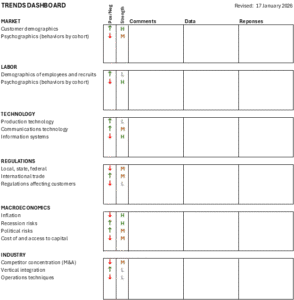
Jimmy Buffett sang, “The world’s too big to understand.” Someone with excellent analytical abilities should build a sensitivity model that could show, for example, how an improved labor pool would affect margins. A mock-up of a “trends dashboard” is shown below; the Excel file is at term 4.4.1.3 Business intelligence.
Find the best possible metric for each big trend, even if the correlations aren’t great. You could track quarterly national metrics, like consumer confidence, CPI, and the prime rate. Your industry might provide predictions for market and employee growth in your sector.
Trust in Collective Decision-Making
If colleagues don’t feel the others are on top of the trends and information in their area, they’ll never be able to make confident, smart, and speedy decisions. Mistrust will accrue. On the other hand, following this best practice will make your executive team more creative, confident, and efficient.
That’s how together you can build a reputation for responsible and visionary leadership.

