
The Humanist Manager in the Age of AI
3 Key Points
- AI is forcing a painful trade-off between high-margin customers and talented office workers.
- Only providing opportunities for genuine collaboration will make good employees want to stay.
- Career opportunities for “humanist managers” will grow in proportion to AI’s adoption.
It’s a stark choice: Adopt AI to stay price competitive but demoralize your employees—or don’t adopt AI and keep your employees until you get out-priced. But there’s a career opportunity: the need for great managers is expanding at the same blistering rate AI is alienating employees.
Forbes reported that Sam Altman, CEO of OpenAI, said in 2024, “In my little group chat with my tech CEO friends there’s this betting pool for the first year that there is a one-person billion-dollar company.”
The bros assumed this AI unicorn will be another tech business, but CEOs of small and mid-sized manufacturers, retailers, and contractors have to scramble to adopt AI as fast as possible.
A friend of the author had a five-person business doing sophisticated virtual reality work. In less than a year, bots let him make it a two-person shop. He told me, “I have more and better clients and produce better work than I ever have.”
If your competitor uses AI to cut costs 10% and prices 5%, and if you don’t match them, you’ll bleed high-margin customers. But there is a huge human cost, as in my friend’s software shop.
While employees know there’s no choice but to ride the AI rocket, it terrifies them: Fortune reported this April that 30% to 40% of workers have FOBO, Fear of Becoming Obsolete. U.S. employee engagement has slid back down to the post-recession, post-Covid levels (Gallup). And the top people always leave first.
Tapping Humanity’s Superpower: True Collaboration
There’s deafening buzz about getting the most out of AI, but how can we help the remaining people see they’re deeply needed?
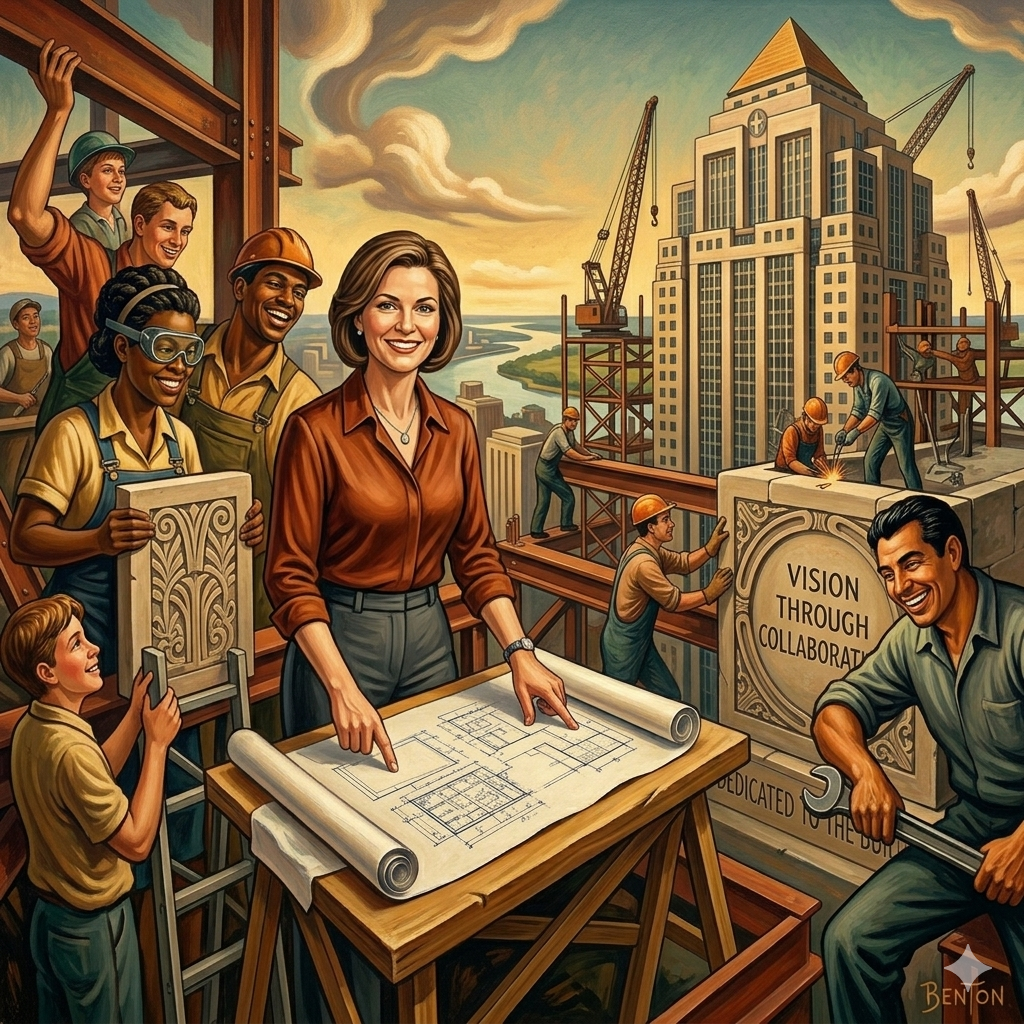
The answer is to tap our species’ collaboration superpower.
When we truly work together, we instantly fill in the gaps in each other’s skills and experience, we spontaneously generate new ideas, and our team spirit powers us over the potholes without losing momentum. Without collaboration, we literally would have been eaten alive 1,000,000 years ago. Because collaboration is innate, collaborating makes us feel great.
An ordinary manager starts by assigning tasks, but a humanist starts by thinking about how to make each employee happy.
Here, I don’t mean “ha ha” happy, I mean happy at the primal level. This means people feel safe, appreciated, and proud—a simple version of Maslow’s hierarchy.
Safe means they’re physically, emotionally, and financially safe. Appreciated means they’re included, respected, and acknowledged. And proud means they get to succeed in work they feel is challenging and meaningful. Humanist managers know that focusing first on happiness doesn’t hinder practical results. It’s the opposite: they know that human-centric management always yields steadily excellent returns. Teams with competent and caring bosses blow past the prima donnas. It just takes a new way of thinking.
The Perspective Shift: How Can Project Management Make People Happy?
Humanist managers ask questions like, “How can project management make people happy?”
That question might sound weird, so let me break it down:
Safe: No team member feels safe if the manager hasn’t provided a clear purpose or plan: the team will always be swimming in a pool of uncertainty. A humanist manager also provides enough time and money, so people aren’t perpetually panicked.
Appreciated: Humanists know their people, often better than their people know themselves. A well-constructed project team includes just the right people, and it’s only as big as it needs to be. That lets everyone see and sincerely praise each other’s contributions; bloated teams dilute everyone’s chance to be appreciated.
Proud: 50% of projects fail, so half the time there’s nothing to be proud of. Great managers make sure each project is glaringly important to the strategic plan so executive support never waivers.
Humanist managers still need great project management skills (or meeting management or planning or process improvement skills). But the humanist uses those skills to marshal the deep drive for collaboration. Their competence lets each teammate hurry home, proud to report how they spent their day. The old attitude of “I own your time, so if I waste it, that’s my problem” will drive people away.
Could You Be a Humanist Manager?
Fewer than half of employees trust their managers—and that’s today. AI will quickly erode that trust further, and that’s bad for everyone.
Look deeply into yourself. Could you be a humanist manager, someone driven to help others collaborate in a way that makes them feel safe, appreciated, and proud? It’s demanding work, but what could be more rewarding?
Related Best Practices


.png)